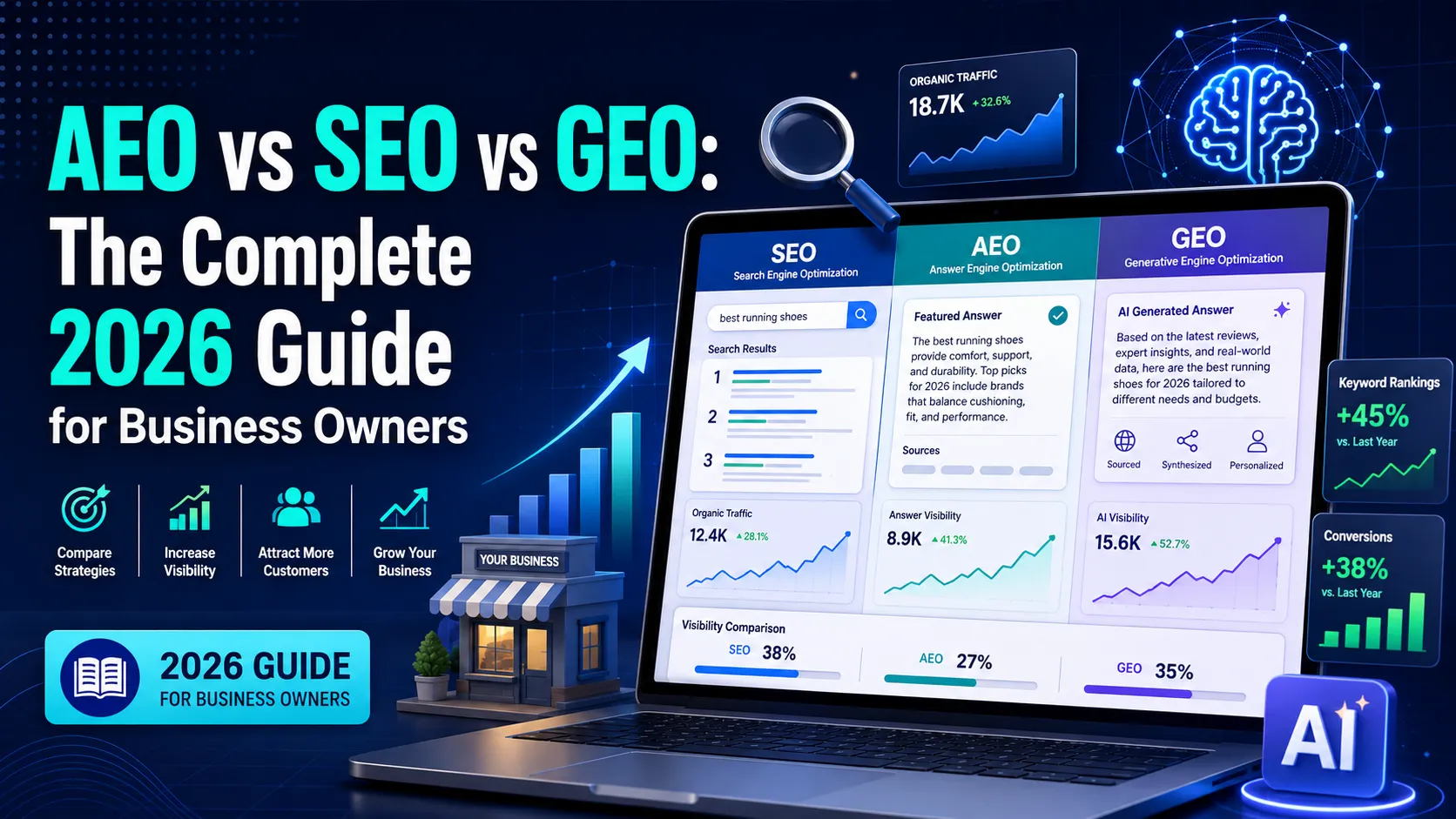
AEO vs SEO vs GEO: The Complete 2026 Guide for Business Owners
On this page
If you run a business in 2026, you have probably noticed something: fewer people are clicking, and more people are asking. They ask ChatGPT for recommendations. They read Google’s AI Overview and never scroll. They type a question into Perplexity and trust the answer it writes back. Three letters now decide whether your business shows up in those moments: SEO, AEO, and GEO. This guide explains what each one means, how they differ, and how to use all three together.
The short answer
SEO gets you ranked. AEO gets you the answer box. GEO gets you mentioned inside AI-generated responses. They are not competing strategies. They are three layers of the same goal: being the business that gets found and recommended.
What is SEO?
SEO (Search Engine Optimization) is the practice of making your website easy for search engines like Google to find, understand, and rank. It rests on three pillars: relevance (does your content match the search?), authority (do other trusted sites link to you?), and technical health (is your site fast, secure, and mobile-friendly?).
SEO is far from dead. Google still handles billions of searches a day. But ranking number one no longer guarantees a click, and it no longer guarantees you appear in AI answers.
What is AEO?
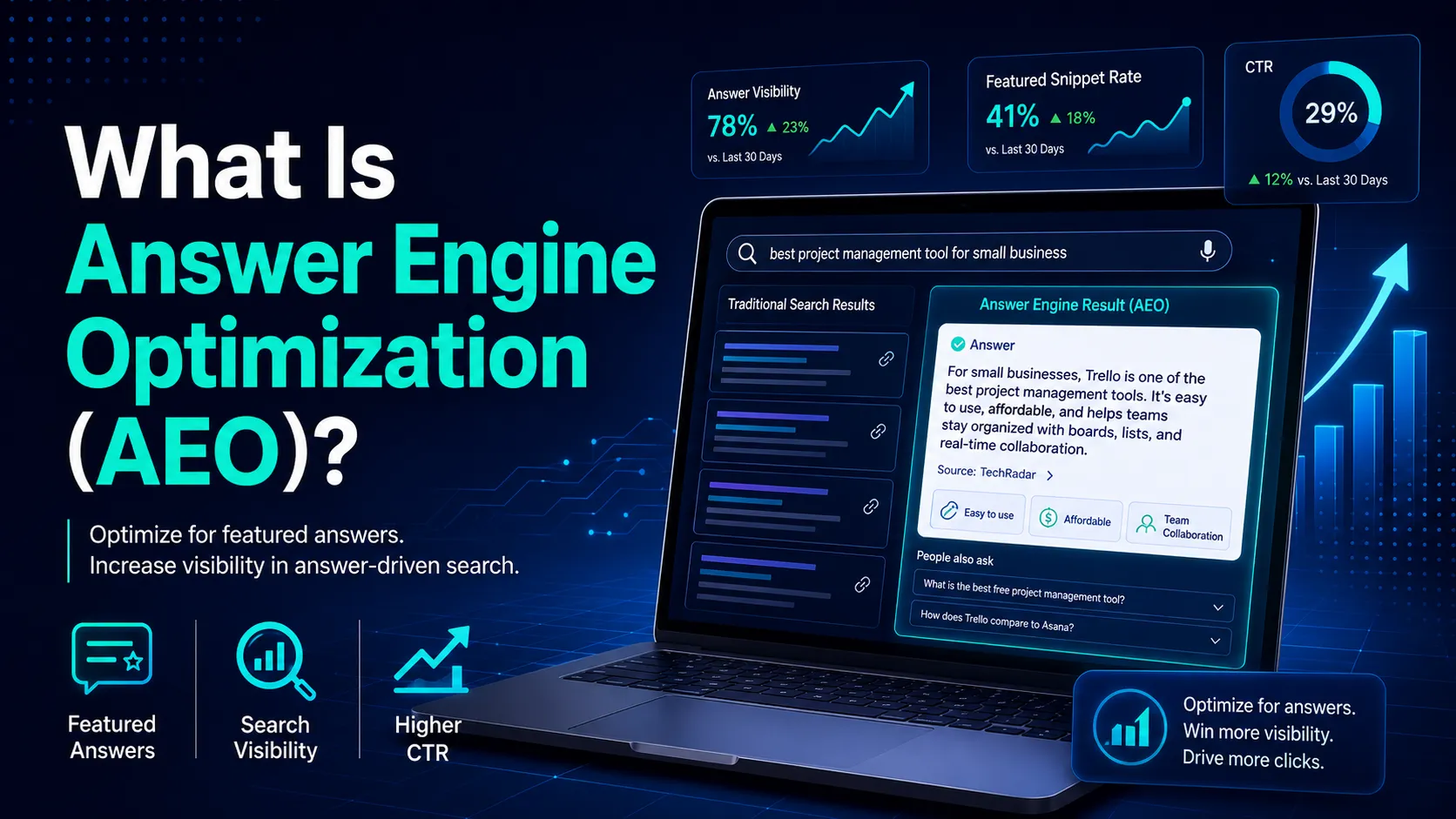
AEO (Answer Engine Optimization) is the practice of structuring your content so answer engines can extract a direct answer from it: Google’s AI Overviews, featured snippets, People Also Ask boxes, and voice assistants. The goal is not just to rank. It is to be the answer shown above the results.
AEO rewards clear, structured content: questions as headings, direct answers in the first sentence, FAQ sections, and schema markup that tells machines exactly what your page says.
What is GEO?
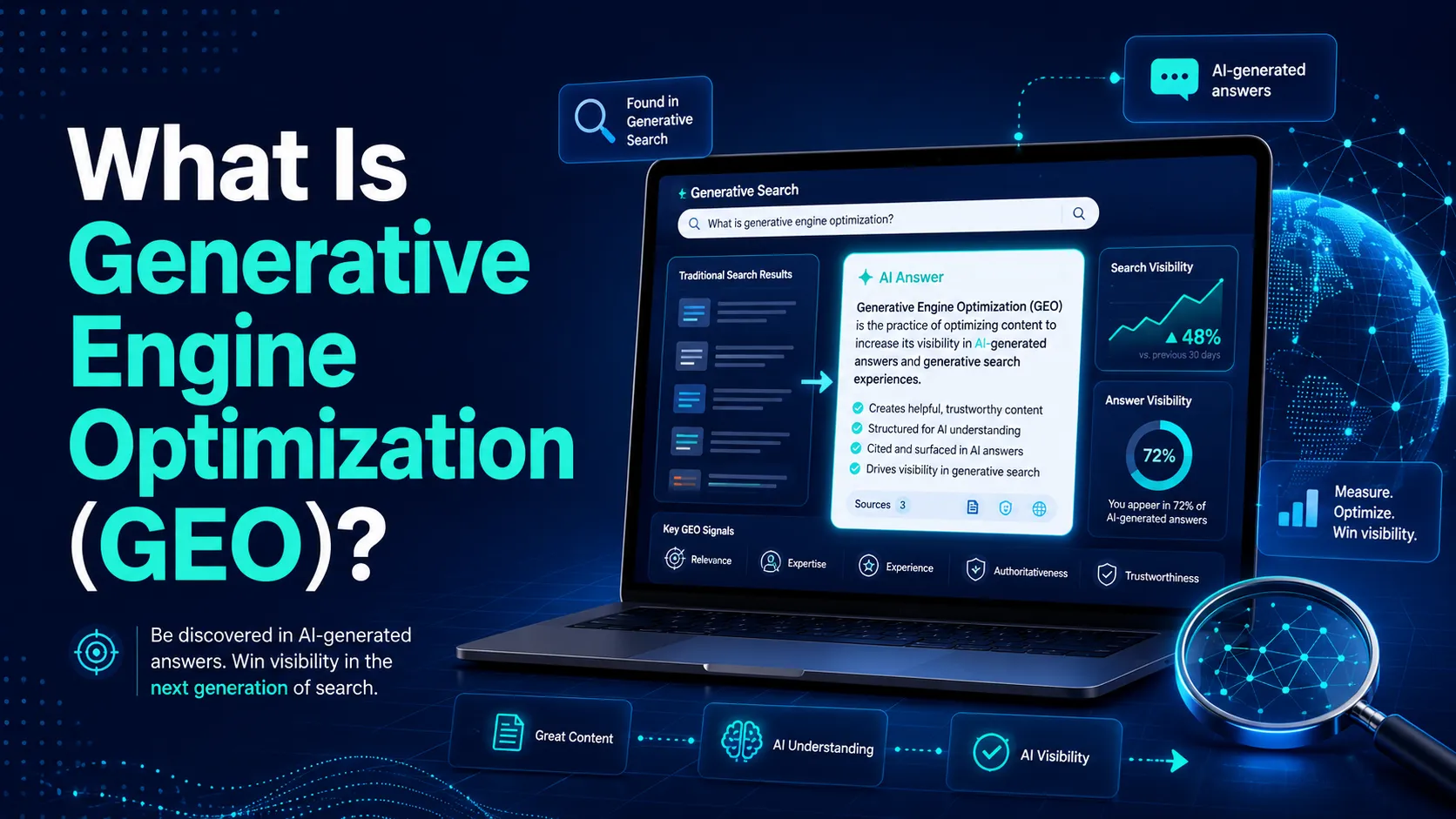
GEO (Generative Engine Optimization) is the practice of getting your brand selected and cited by generative AI systems such as ChatGPT, Perplexity, Gemini, and Claude when they synthesize an answer from across the web. When someone asks ChatGPT who the best provider for something is, GEO determines whether your name appears in the reply.
GEO depends heavily on signals beyond your own website: consistent mentions across credible third-party sources, reviews, directories, and digital PR. AI systems build a picture of your brand from the whole web, not just your homepage.
AEO vs GEO: are they the same?
They overlap so much that many marketers use the terms interchangeably. The practical difference: AEO is about being extracted as the answer in search-engine features like AI Overviews and snippets. GEO is about being cited or mentioned inside a generative chatbot’s response. Optimize for one and you usually help the other. Both reward clear, credible, well-structured, frequently referenced content.
The three layers compared
- SEO rank high in Google results, driven by keywords, backlinks, and technical health.
- AEO become the extracted answer in AI Overviews, snippets, and voice, driven by structure, clarity, schema, and FAQs.
- GEO get cited or recommended in ChatGPT, Perplexity, Gemini, and Claude, driven by authority, consistency, third-party mentions, and freshness.
Why this matters right now
Gartner has predicted traditional search volume could fall 25% by 2026 as people shift to AI assistants. Studies show AI answers frequently cite sources that are not the top organic Google results, which means you can rank number one and still be invisible in AI answers. The businesses building AEO and GEO strategies today are doing it before most competitors have even heard the terms.
How to win at all three
- Nail your SEO foundations. A fast, secure, mobile-friendly site, a claimed Google Business Profile, and quality backlinks. These also feed AEO and GEO.
- Structure content for extraction. Use question-style headings and answer them directly. Add FAQ sections. Implement FAQ, Article, and Organization schema.
- Build off-site authority. Reviews, directory listings, guest articles, and press mentions are how AI decides who to cite.
- Keep it fresh. Update key pages every three to six months. Perplexity in particular rewards recency.
- Be consistent. Make sure every platform describes your business the same way, so AI builds one clear picture of who you are.
The bottom line
SEO, AEO, and GEO are three floors of the same building. The foundation is shared: genuinely helpful, clearly structured, credible content. Get that right and you will be found whether your customer is Googling it or asking an AI.
Want your brand to show up across Google, ChatGPT, Gemini, and Perplexity? Opamedia builds SEO, AEO and GEO visibility that turns search and AI answers into leads. Book a discovery call to start the conversation.
Want to be the answer AI engines cite?
Opamedia builds websites, AI automation, and SEO/AEO/GEO visibility that turn search and AI answers into qualified leads.
Book a Discovery Call